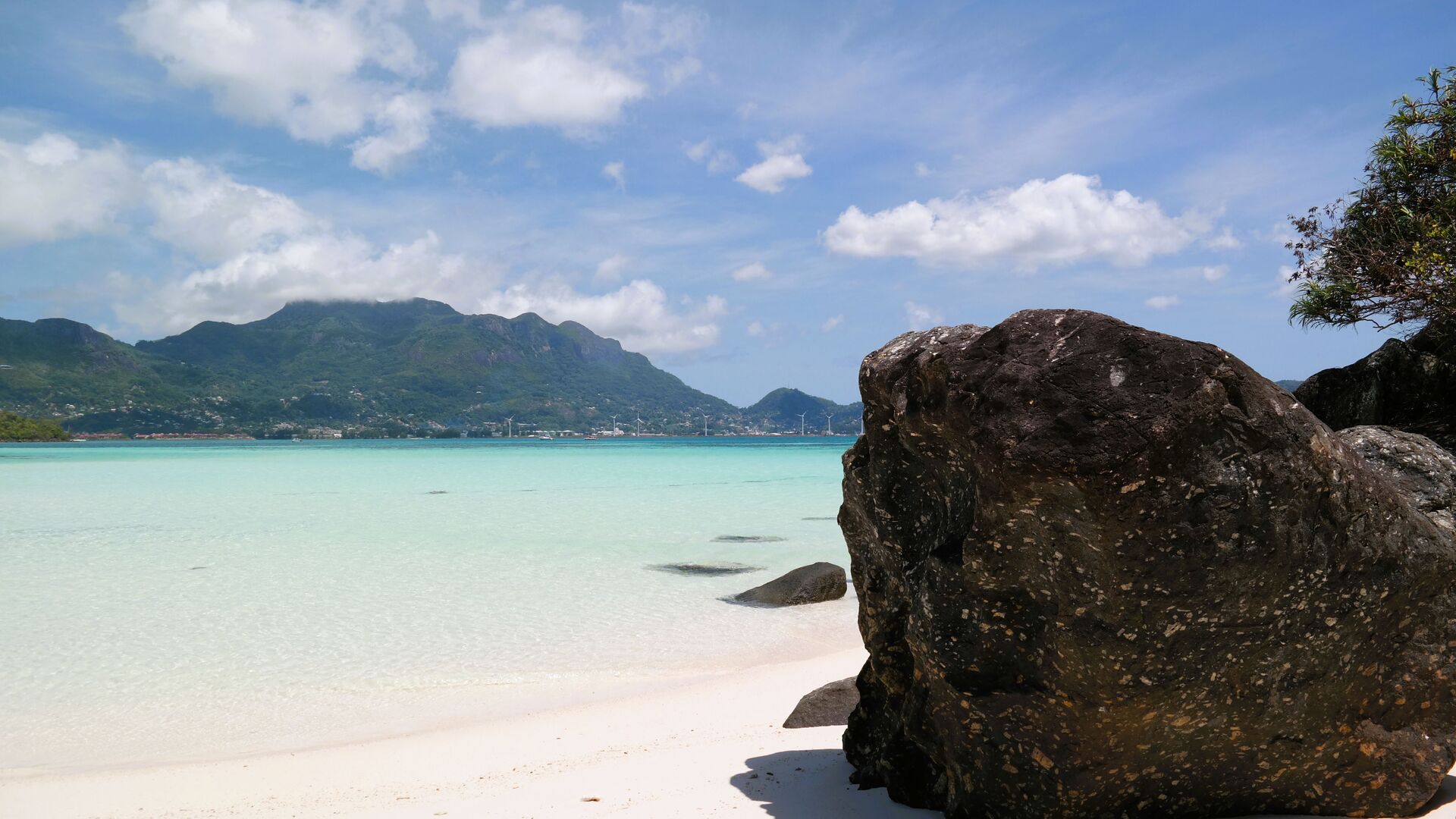
Seychelles:and the other island, beach and mountains
Independence Day: 29 June 1976. Capital: Victoria. One hundred and fifteen islands scattered across a million square kilometres of the Indian Ocean, and about one hundred and twenty thousand people — the smallest country in Africa by population and the richest by income per head. Nobody lived here at all until the French arrived in 1770. Part of the population descends from Africans the Royal Navy took off Arab slave dhows and landed here in the 1860s. And for a quarter of a century Britain used these islands as the place it sent the kings it had defeated — including the Asantehene of Kumasi, and the woman who led the last war against the British in Asante.
Three things, and the first one belongs to Ghana.
When Britain deposed Asantehene Prempeh I in 1896 and later put down the War of the Golden Stool in 1900, it did not execute the leaders. It shipped them to the Seychelles — far enough that no rescue was conceivable, remote enough that they could not become a rallying point, and pleasant enough that nobody in London had to be embarrassed.
Prempeh I spent twenty-eight years on these islands. He was baptised there, learned English there, raised a family there, and did not see Kumasi again until 1924.
This site's Ghana page describes what happened in Kumasi. This is where they were sent. If your network covers Ghanaian heritage, the Seychelles is not an exotic footnote — it is an annex of Ghanaian history sitting four thousand kilometres out in the Indian Ocean.
The second thing is that Seychelles is the third country in this series — with Mauritius and São Tomé — where there was no indigenous population at all, and therefore no dispossession, only importation.
And the third is that this tiny, orderly, prosperous place has had a coup, a one-party state, a mercenary invasion mounted by a South African rugby team, a truth commission, and a drug epidemic that is proportionally among the worst in the world.
Seychelles:and the other island, beach and mountains
The islands were known to Arab and Austronesian sailors and appear on Portuguese charts from the sixteenth century, but nobody settled them.
The French took formal possession in 1756 and named them after Jean Moreau de Séchelles, Louis XV's finance minister. The first settlement came in 1770, from Mauritius: a handful of French planters with enslaved Africans and Malagasy, growing spices, cotton and coconut.
Britain took the islands during the Napoleonic wars and kept them under the Treaty of Paris in 1814. They were administered as a dependency of Mauritius until 1903, when they became a separate Crown Colony.
British rule left the French language, French place names and French Catholicism in place, exactly as it did in Mauritius. Seychellois Creole is French-based, and it is the first official language.
And here is the founding story that almost no other country has.
Slavery was abolished in the British Empire in 1834–35. The Royal Navy then spent decades intercepting slaving dhows in the Indian Ocean, running captives from the East African coast to Arabia and the Gulf.
People taken off those ships had to be landed somewhere, and a great many of them were landed in the Seychelles — something in the order of two to three thousand in the 1860s and 1870s. They were called Liberated Africans, apprenticed to plantations, and settled at mission stations, the best known being Venn's Town in the hills above Mahé, now the Mission Lodge ruin that every visitor photographs without being told what it is.
A substantial part of the modern Seychellois population descends from people who were freed from a slave ship and put ashore on an island they had never heard of.
That is a distinct category. Not enslaved settlers, not indentured labour, not colonists — rescued cargo, resettled, with no possibility of return and no community waiting.
From the 1870s the British began using the colony for a purpose that had nothing to do with coconuts.
The Seychelles became an imperial place of exile — for rulers and religious leaders whom Britain had defeated but did not want to make into martyrs.
Sultan Abdullah II of Perak was sent here after the Perak War. So were figures from the Sudan and Egypt, from Zanzibar and from Palestine. Archbishop Makarios III of Cyprus was deported here in 1956, held at Sans Souci above Victoria, and released the following year to become the first president of an independent Cyprus.
And in 1900, after the War of the Golden Stool, the Asante royal party arrived — Prempeh I, his mother, members of the court, and Yaa Asantewaa. Some fifty-odd people in the group over time.
The logic of it deserves to be stated plainly. Britain had learned that killing a defeated African ruler created a story. Exiling him to an island in another ocean created silence. It was an administrative technology, and it was used deliberately and repeatedly.
Prempeh I was permitted home in 1924; the Asante Confederacy was formally restored in 1935. Yaa Asantewaa's grave in the Seychelles is a place of Ghanaian pilgrimage today, and the connection between the two countries rests on it.
Independence came very late, and without much pressure for it.
The islands were poor, remote, and — until the airport opened at Pointe Larue in 1971 — reachable only by ship. The airport is the single most consequential thing that ever happened to the Seychelles, because it created tourism, and tourism created a reason to be a country.
Two parties dominated: the Seychelles Democratic Party of James Mancham, which favoured continued association with Britain, and the Seychelles People's United Party of France-Albert René, which wanted independence and socialism.
Independence came on 29 June 1976, with Mancham as president and René as prime minister in a coalition.
It lasted eleven months.
On 5 June 1977, while Mancham was at the Commonwealth heads of government meeting in London, René's supporters took over the islands overnight, with weapons reportedly supplied through Tanzania. Mancham learned that he was no longer president while abroad and did not return for fifteen years.
René ruled for twenty-seven years: a one-party socialist state from 1979, with free education and health care, a large Tanzanian and later North Korean security relationship, and detention, disappearance and torture for opponents.
And then, in 1981, the Seychelles produced the single most extraordinary episode in this entire series.
On 25 November 1981, a party of around forty-four men landed at Mahé airport describing themselves as a beer-drinking rugby and social club: "Ye Ancient Order of Froth Blowers."
They were mercenaries, led by "Mad Mike" Hoare, the Irish-South African veteran of the Congo. Their AK-47s were in false-bottomed sports bags. The operation, backed with the knowledge and assistance of elements of the South African state, was intended to restore Mancham.
A customs officer opened the wrong bag.
A firefight broke out in the terminal. Most of the mercenaries then hijacked an Air India Boeing 707 that happened to be on the ground and flew it to Durban. A handful were left behind, captured and tried; several were sentenced to death and later released.
In South Africa, Hoare and his men were prosecuted for hijacking; he served a prison sentence.
A United Nations Security Council commission of inquiry found South African involvement, and the affair is one of the clearest documented instances of Pretoria's destabilisation of independent African states — the same programme described on this site's Mozambique, Lesotho and Eswatini pages.
The consequence inside Seychelles was predictable: the security state tightened, and it stayed tight for another decade.
Under donor and domestic pressure, René restored multiparty politics in 1991, and a new constitution was adopted in 1993. He then won three elections under it, which tells you something about how thoroughly the party and the state had merged.
He handed over to James Michel in 2004, who handed over to Danny Faure in 2016. The same party held power continuously from 1977 to 2020 — forty-three years.
Then, on 25 October 2020, Wavel Ramkalawan won — an Anglican priest of Bihari descent who had contested and lost five previous presidential elections. It was the first opposition victory and the first peaceful transfer of power in the history of the Seychelles.
And in 2025 it happened again, in the other direction.
The general election of 27 September 2025 put Patrick Herminie of United Seychelles narrowly ahead — 48.8 per cent to Ramkalawan's 46.4 — forcing a run-off held from 9 to 11 October. Herminie won it with about 52.7 per cent and was sworn in on 26 October 2025 as the sixth president.
Two of the issues that decided it are worth recording.
The first was a lease. The Ramkalawan government agreed a seventy-year lease of a large part of Assumption Island — next door to the Aldabra atoll, a World Heritage site — to a Qatari-linked luxury hotel developer. The protests were substantial. Herminie campaigned to cancel it and accused Qatar of financing his opponent's campaign.
The second was that Herminie had been arrested in 2023 and accused of plotting a coup with the assistance of witchcraft. The charges were dropped. He then won the presidency.
One thing the Seychelles did that very few African states have managed.
The Truth, Reconciliation and National Unity Commission sat from 2018 and delivered its final report in 2023, examining the period from the 1977 coup onwards: the disappearances, the torture, the confiscations, the patronage.
It was created while the party responsible was still in power, and it heard cases in public.
Its final report called for reparations — apologies and monetary compensation for victims.
Set it beside the record this network has assembled: Morocco's commission paid and prosecuted nobody; Liberia's named fifty people and produced nothing; The Gambia's produced a tribunal with no money; Guinea convicted and then pardoned. The Seychelles is one of the very few places where a commission reported and its own successors are now being asked to pay.
Whether they do is the live question, and the party whose era is under examination returned to power in October 2025.
Seychelles has the highest income per head in Africa — over seventeen thousand dollars — and it is not close.
Tourism is roughly forty-five per cent of the economy. 2025 was a record: 398,841 arrivals, up thirteen per cent on 2024 and above the pre-pandemic peak, with tourism receipts estimated at $1.2 billion and average spending per visitor up over fourteen per cent. Growth was around five per cent.
Tuna is the other half. The cannery at Victoria is one of the largest tuna processing plants in the world, the port is a major Indian Ocean transhipment hub, and EU fishing agreements have been a durable and contested source of revenue.
And then there are the vulnerabilities, which are total.
Almost everything is imported. Tourism is one bad year away from a fiscal crisis — Fitch projected a ten per cent fall in arrivals and an eight per cent fall in tourism revenue for 2026 on the back of the Iran conflict's effect on regional air travel. Public and guaranteed debt is projected to rise from 53.6 per cent of GDP at the end of 2025 to about 57.2 per cent at the end of 2026.
Twenty-three per cent of the population lives in poverty in the richest country in Africa.
And the drugs. Seychelles has, proportionally, one of the worst heroin problems on earth: estimates that around ten per cent of the working-age population uses heroin have been cited repeatedly in Seychellois politics and in international reporting. In a country of 120,000 people on a maritime route between Afghanistan and East Africa, with money, boredom and boats, the epidemic arrived and has not been contained by either party.
That single statistic is the most important thing on this page about the modern Seychelles, and it almost never appears in anything written about the islands abroad.
The Seychelles is also one of the genuinely important places on earth ecologically, and it has done something financially clever about it.
Aldabra is the world's second-largest raised coral atoll, a UNESCO World Heritage site, and home to around one hundred thousand giant tortoises — the largest population of giant tortoises anywhere, far exceeding Galápagos. It is so remote that it survived largely untouched.
And Britain nearly put an airbase on it. In the 1960s Aldabra, along with Farquhar and Desroches, was detached from the Seychelles into the British Indian Ocean Territory — the same administrative act described on this site's Mauritius page that produced the Chagos deportations. Plans for a joint British-American staging base on Aldabra were developed and, after a scientific campaign, dropped. The islands were returned to Seychelles at independence in 1976.
Seychelles got its islands back. Chagos did not, until 2025. The difference was that nobody was living on Aldabra to be removed.
The Vallée de Mai on Praslin is the second World Heritage site: a palm forest holding the coco de mer, which produces the largest seed of any plant on earth and whose suggestive shape made it the most valuable botanical curiosity in Europe for two centuries.
And the financing is a genuine innovation. In 2015 Seychelles concluded a debt-for-nature swap with The Nature Conservancy — restructuring part of its sovereign debt in exchange for binding marine protection commitments — and in 2018 it issued the world's first sovereign blue bond. On the back of these, around thirty per cent of its exclusive economic zone was placed under protection.
A small state used its own debt as leverage to protect an area of ocean larger than Germany. Every indebted coastal country on this continent should be studying it, and the mechanism has since been copied in Belize, Ecuador and Gabon.
Because the Seychelles is where the British Empire put the people it had defeated.
That is not a metaphor. It was a policy, it was applied to an Asante king, an Asante queen mother, a Malay sultan and a Cypriot archbishop, and it worked in the sense that mattered to London: none of them became a rallying point while they were gone.
Prempeh I came back after twenty-eight years to a kingdom that had been formally abolished. Yaa Asantewaa did not come back at all.
And the Seychelles is the counter-example on everything else. Read the other fifty-three pages, then read this one: highest income in Africa, two peaceful changes of government in five years, a truth commission that reported and recommended reparations, a debt instrument that protects a third of its ocean, and a hundred thousand tortoises.
And twenty-three per cent poverty, a heroin epidemic at a scale almost nowhere else matches, an economy that stands or falls on the number of aircraft that land, and an island next to a World Heritage site leased out for seventy years.
Size does not exempt you. It just means that everything — the tourism, the debt, the drugs, the leases, the geopolitics of India and China circling for an anchorage — arrives at the same small harbour at the same time.
There is no indigenous population and therefore no indigenous claim. Everyone here came, was brought, or was rescued and put ashore. That makes the Seychelles unusual and it makes the moral arithmetic different from everywhere else on this site.
The French planters brought enslaved people; the British freed them and then apprenticed them to the same plantations. The Liberated Africans were not free in any sense a modern reader would accept for a generation after they landed.
René's coup was popular with many Seychellois, and the state he built delivered free education, free health care and a level of social provision that the colony had never offered. It also disappeared and tortured people, which is what the commission established and what his own party now has to answer for from government.
The 1981 mercenary operation was a South African destabilisation of a sovereign African state, and it is almost always told as a comic caper about false-bottomed bags. It was not comic at the receiving end.
And the islands are a tax haven. Seychelles built a substantial offshore corporate services industry, spent years on grey lists, and has cleaned it up under pressure — but a great deal of money that moved through Victoria came out of somewhere else on this continent.
Two things are true. The Seychelles is the most successful small state in Africa by almost every measure. And it holds the graves of people who were sent there so that Ghana would stay quiet.
There are one hundred and fifteen islands that nobody lived on until 1770.
There are two to three thousand people taken off slaving dhows by the Royal Navy and put ashore on an island they had never heard of.
There is a mission station in the hills above Mahé where their children were schooled, now a ruin with a view.
There is a king from Kumasi who arrived in 1900 and left in 1924.
There is a woman from Ejisu who went to war at sixty and died here on 17 October 1921.
There is an archbishop held at Sans Souci in 1956 who became a president the year after he was released.
There is an airport that opened in 1971 and made the country possible.
There is a coalition that lasted eleven months and a night in June 1977 when the president was at a conference in London.
There are forty-four men who landed in November 1981 calling themselves a rugby club, and a customs officer who opened the wrong bag.
There is a hijacked Air India 707 that left for Durban the same evening.
There is a commission that reported in 2023 and asked the state to pay its own victims.
There is a first opposition victory in 2020, forty-three years after the coup, and a second change of government in October 2025.
There are one hundred thousand giant tortoises on an atoll that Britain nearly turned into an airbase.
There is a seed that Europe paid fortunes for because of what it looked like.
There is a sovereign bond, the first of its kind in the world, that bought protection for a third of an ocean.
And there is a country with the highest income in Africa in which something like one in ten working-age adults uses heroin.
Updated and fact-checked: 17 September 2026.
How this page was checked. Recent political and economic developments were verified against the sources listed above; the earlier history was checked against standard reference works on the Seychelles, the Indian Ocean slave trade and British imperial exile. The French possession of 1756 and first settlement in 1770, the British capture and the Treaty of Paris of 1814, administration as a dependency of Mauritius until the separate Crown Colony of 1903, the abolition of slavery in 1834–35 and the subsequent landing of Liberated Africans taken from slaving dhows, the use of the islands as a place of imperial exile including the deportation of Asantehene Prempeh I in 1900 and of Yaa Asantewaa in 1901, the death of Yaa Asantewaa on 17 October 1921 and the return of Prempeh I in 1924, the exile of Archbishop Makarios III in 1956–57, the detachment of Aldabra, Farquhar and Desroches into the British Indian Ocean Territory in the 1960s and their return at independence, the opening of the international airport in 1971, independence on 29 June 1976, the coup of 5 June 1977 and the one-party state that followed, the mercenary landing of 25 November 1981 and the hijacking of an Air India aircraft to Durban, the restoration of multiparty politics in 1991 and the constitution of 1993, the transfers of office in 2004 and 2016, the debt-for-nature swap of 2015 and the sovereign blue bond of 2018, the work of the Truth, Reconciliation and National Unity Commission from 2018 and its final report in 2023, the opposition victory of 25 October 2020, and the general election of September and October 2025 are as recorded. Figures are estimates or official series as indicated: the number of Liberated Africans landed in the Seychelles in the 1860s and 1870s is generally given as around two to three thousand; the number of giant tortoises on Aldabra is generally given as around one hundred thousand; income per head, poverty rate, arrivals, tourism receipts and debt ratios are as reported in the sources above and vary between GDP and GNI measures. The estimate that around ten per cent of the working-age population uses heroin is widely cited in Seychellois political debate and international reporting; it is an estimate and no definitive survey establishes it. A United Nations commission of inquiry found South African involvement in the 1981 mercenary operation; the South African government of the day disputed the extent of that involvement. Patrick Herminie was arrested in 2023 in connection with an alleged plot; the charges were dropped and he has not been convicted of any offence, and nothing here should be read as asserting otherwise. Allegations concerning the financing of the 2025 election campaign were made during that campaign and have not been established. The findings of the Truth, Reconciliation and National Unity Commission are the Commission's own; its recommendations on reparations have not been implemented. This page makes no allegation against any living person beyond matters already on the public record.
Written and researched by Remo Kurka · africanindependence.com
We strive to unify diverse narratives from across Africa, showcasing the continent's shared heritage and unique stories.
Our mission is to honor and preserve the history of African cultures and independence movements for future generations.
We provide a platform for innovative exchange of ideas, resources, and insights, understanding that knowledge should be accessible to all.