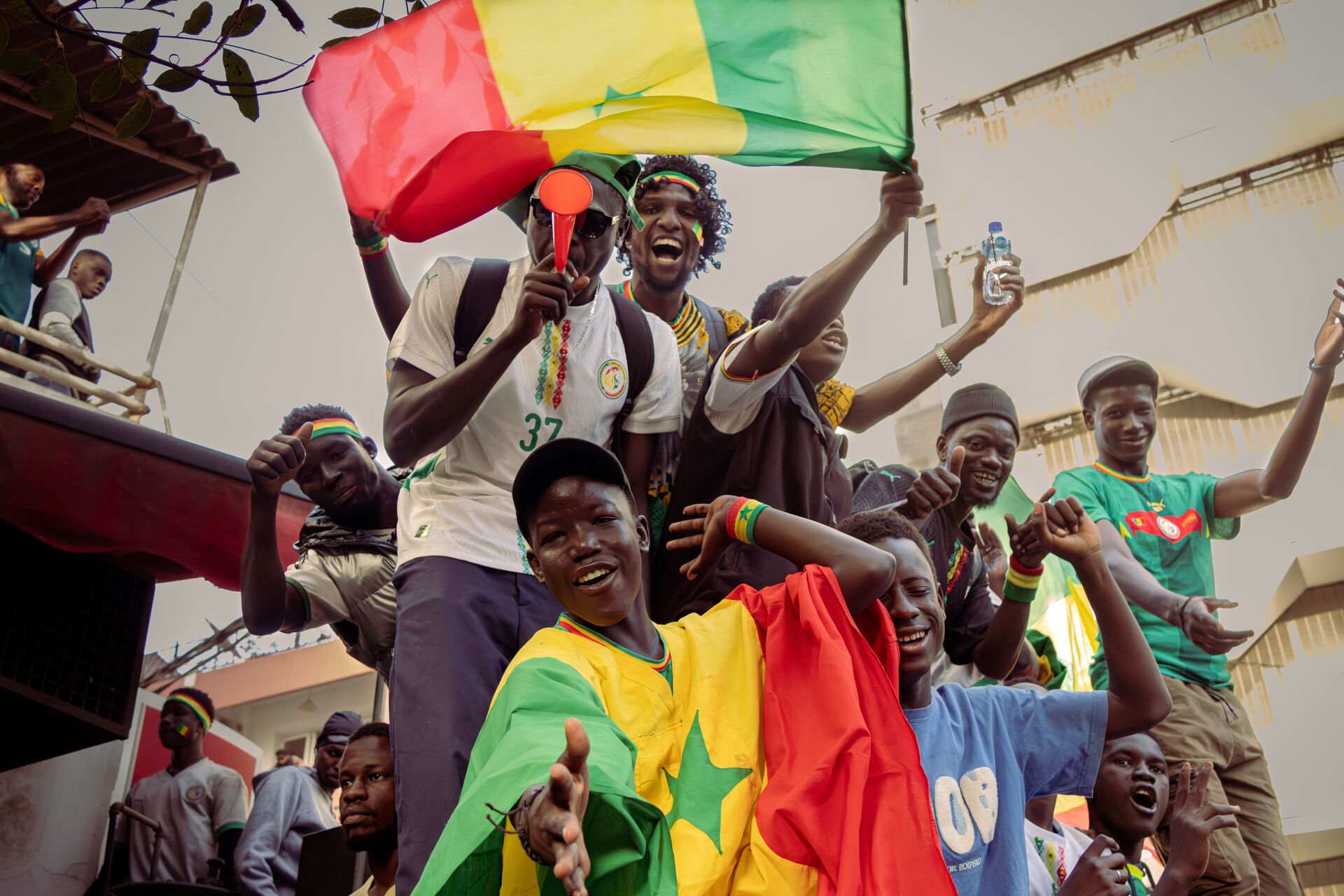
Senegal and people celebrating with Flags of Senegal
Independence Day: 4 April 1960. Capital: Dakar. In sixty-six years Senegal has never had a coup — the only mainland West African country of which that is true. It has changed its government by ballot four times.
In February 2024 a sitting president tried to postpone the election that would replace him; the Constitutional Council ruled that he could not, and the man who won was released from prison ten days before the vote. Then his government opened the accounts and found about seven billion dollars of debt that nobody had been told about.
Senegal is the country other West Africans point to when they are arguing about whether any of this works.
While Mali, Burkina Faso, Niger and Guinea have gone to juntas — four of them described elsewhere on this website — Senegal has held to civilian rule since 1960. Its army has stayed in barracks through economic collapse, a thirty-year insurgency in its own south, and a genuine constitutional crisis in 2024 that it could easily have "resolved".
And this page has to do something else that most accounts of Senegal avoid.
Gorée Island, off Dakar, is the most visited site of memory of the Atlantic slave trade in the world. Popes, presidents and Nelson Mandela have stood in the doorway there. The numbers commonly recited at that doorway are not supported by the historical record, and Senegalese historians have said so for forty years.
Getting that right matters, and it matters most to people who want reparations and restitution taken seriously. A case built on a number that collapses under examination hands the other side the argument. This site has made that point about Nigerien uranium and about the bones at Abu Salim, and it applies here too.
Senegal and people celebrating with Flags of Senegal
The Jolof Empire dominated the region from the fourteenth century until it fragmented in the sixteenth into the kingdoms that shaped everything after: Waalo, Kajoor, Baol, Siin, Saalum, and in the north the Fulani and Tukulor state of Futa Toro.
These were real states with courts, cavalry, taxation and succession disputes, and they were also deeply involved in the Atlantic trade — supplying captives from wars and raids to the French and Portuguese posts on the coast, and being raided in turn.
To the south, in the forests and creeks of Casamance, the Jola lived in decentralised societies with no kings — which is why the French had nobody to rule through there, and why Casamance's relationship with Dakar has been difficult ever since. Along the Petite Côte and in Siin, the Serer held out against Islam longer than anywhere else in the region.
You cannot understand Senegal without this, and outsiders routinely skip it.
Senegal is over ninety per cent Muslim, and Senegalese Islam is organised through Sufi brotherhoods — above all the Tijaniyya and the Mouridiyya.
Cheikh Amadou Bamba founded the Mouride order in the 1880s and built its centre at Touba. He preached work and self-discipline rather than armed resistance. France exiled him anyway — to Gabon from 1895 to 1902, then to Mauritania — because a man who could command that many followers was a threat whatever he preached.
His return is commemorated every year at the Grand Magal of Touba, which draws millions of people and is one of the largest annual religious gatherings on earth.
The Mourides organised groundnut cultivation, then urban trade, then a global diaspora commercial network running through Paris, Milan, Brooklyn and Hong Kong, with money flowing back to Touba.
And the brotherhoods and the state have an understanding. Politicians seek the blessing of the caliphs; the caliphs keep their followers inside the system. It is not written down, it has never been secret, and it is one of the main reasons Senegal has had no coup: a general who seized power without the marabouts would find himself governing nobody.
Gorée Island was inscribed by UNESCO in 1978 as its first World Heritage site in Senegal, and the Maison des Esclaves with its Door of No Return has become the global site of pilgrimage for the African diaspora.
Here is what the historical record supports. Gorée was a French trading station, and captives did pass through it. It was, however, a minor point of embarkation compared with the Bight of Benin, the Bight of Biafra, Loango or Luanda — the reef and the anchorage made loading difficult, and the volumes recorded in the trade databases are modest: thousands over the whole period, not millions. The Maison des Esclaves itself was built around 1780 as the house of a wealthy signare — a Euro-African woman merchant — with storage below and residence above.
Senegalese and international historians have made this argument in public since the 1980s, and it has been fought over bitterly, because it sounds like a denial and is not one.
So state both things. The island is not where twelve and a half million people left Africa. And it is, unarguably, where the world now goes to confront that they did. The diaspora built it into what it is because a place was needed and Gorée was reachable, photogenic and Senegalese hospitality met it. That is a legitimate function, and the visitor standing in the doorway is not being deceived about what the Atlantic trade was — only, sometimes, about the arithmetic of that specific door.
The honest version costs nothing and protects everything else.
France ran Senegal differently from anywhere else in Africa, and it produced consequences nobody intended.
Saint-Louis, founded in 1659, is the oldest French settlement in Africa and was the capital of French West Africa until 1902. Along with Gorée, Rufisque and Dakar, it formed the Four Communes — and from the nineteenth century, Africans born in those communes held French citizenship and the right to vote, while everyone else in the empire was a sujet under the indigénat.
In 1914 the Four Communes elected Blaise Diagne to the French National Assembly — the first Black African deputy in the French parliament.
Diagne then did something that has been argued about for a century. He secured a law confirming citizenship rights for the originaires — and in exchange he became France's chief recruiter of African soldiers for the First World War, travelling West Africa raising tens of thousands of men for the trenches.
The Tirailleurs Sénégalais — a name that covered Africans from across the federation, not only Senegalese — fought in both world wars in very large numbers, and died in them.
And this is the page's hardest date.
At the Thiaroye camp outside Dakar, around 1,300 African soldiers — demobilised veterans of the war in Europe, many of them former German prisoners of war — were waiting to be paid the back pay and demobilisation allowances they were owed before going home.
They were not paid. They protested. On 1 December 1944, French forces opened fire on them.
The official French figure was 35 dead. Historians working in the archives have argued for figures of several hundred, and the disposal of the bodies has never been satisfactorily accounted for. Survivors were court-martialled and imprisoned.
Thiaroye is the founding wound of Senegalese nationalism, and Sembène Ousmane's 1988 film Camp de Thiaroye was banned in France for a decade.
And in 2024 something moved. Six of the dead were granted the status Mort pour la France in June 2024. In November 2024 President Macron wrote to President Faye acknowledging that what happened at Thiaroye was a massacre, and in December 2024 France participated in the eightieth anniversary commemoration and agreed to open archives to a joint committee of historians.
Eighty years for a letter. Set it beside the Mau Mau settlement described on this site's Kenya page, the return of King Toera's skull on the Madagascar page, and the German declaration on the Namibia page: the pattern is that European states will eventually acknowledge, and will do it at the point where the last survivors are gone.
Independence has two dates, which is why people get it wrong.
Senegal and French Sudan federated as the Mali Federation, which became independent on 20 June 1960. It lasted about two months — the collapse is described on this site's Mali page — and Senegal seceded on 20 August 1960.
Senegal marks 4 April, the date of the 1960 transfer-of-powers agreement with France, as its national day.
Léopold Sédar Senghor was the first president, and there has been nobody like him in African politics before or since: a poet, a grammarian, a Catholic leading a Muslim country, a prisoner of war in a German camp, a deputy in the French parliament, and — with Aimé Césaire and Léon Damas — one of the three founders of Négritude, the literary and philosophical movement that insisted African civilisation was not an absence but a presence.
He was elected to the Académie française in 1983, the first African to hold one of its forty seats.
He was also an authoritarian for part of his tenure: his prime minister Mamadou Dia was imprisoned for twelve years after the crisis of 1962, and Senegal was effectively a single-party state through the 1960s before Senghor reopened it in the 1970s.
And then, on 31 December 1980, Léopold Senghor resigned.
He handed power to his prime minister, Abdou Diouf, and went to live in France. He is the first president in post-colonial Africa to leave office voluntarily, alive, and by choice. Every page on this website should be read with that sentence in mind.
Diouf governed for nineteen years. He also lost, and accepted it: in 2000, Abdoulaye Wade won, and Senegal had its first change of ruling party by ballot.
Wade built — the motorway, the new airport, and the African Renaissance Monument, a fifty-metre bronze on a hill above Dakar, built by a North Korean company at enormous cost, which Senegalese opinion has never warmed to.
Then in 2011 he sought a third term on a constitutional technicality, and the M23 movement put Dakar in the streets. He lost the 2012 run-off to Macky Sall and conceded by telephone that night.
Macky Sall governed for twelve years. And at the end of them he produced the crisis.
Ousmane Sonko — mayor of Ziguinchor, former tax inspector, and by a distance the most popular politician with young Senegalese — was prosecuted, convicted in a case he said was fabricated, and rendered ineligible. His party, PASTEF, was dissolved in July 2023. Protests in 2021 and 2023 were met with force and dozens were killed.
On 3 February 2024, three weeks before the election, President Sall announced its postponement. The National Assembly voted to delay it to December. It looked, to a great many Senegalese and to the entire region, like the end of the exception.
On 15 February 2024 the Constitutional Council annulled the postponement and held that the president had no power to do it.
Sall complied.
An amnesty law released those held. Sonko, still ineligible, put forward his deputy — Bassirou Diomaye Faye — who was also in prison. Both men were released on 14 March 2024.
The election was held on 24 March. Faye won in the first round with 54 per cent. He was 44 years old, had never held elected office, and had been in a cell ten days earlier. His opponent, the ruling party candidate, conceded before the official count was finished.
Sonko became prime minister. In November 2024, PASTEF took a supermajority in the National Assembly.
It is the most complete peaceful transfer of power from an incumbent party to its jailed opposition anywhere on this continent, and it happened because a court ruled and a president obeyed.
The new government commissioned an audit, and the Court of Auditors reported in February 2025.
Debt and deficit figures reported under the previous administration had been misstated on a very large scale. The concealed liabilities have been put at around seven billion dollars — in one reckoning, hidden loans equivalent to about 25 per cent of GDP. The real debt-to-GDP ratio was not around seventy-four per cent but, once everything was counted, around 132 per cent.
The IMF confirmed the concealment and froze its $1.8 billion facility. Moody's downgraded Senegal three times, to Caa2. Dollar bonds fell to around fifty cents.
A country that had just conducted the cleanest democratic transfer in West Africa discovered it was insolvent.
What followed split the government that had won together.
Sonko refused any debt restructuring, arguing that it would surrender economic sovereignty, and pledged in August 2025 to take on no new external debt. Faye concluded that there was no path that did not run through the IMF.
On 22 May 2026, President Faye dismissed Prime Minister Sonko and dissolved the government. On 25 May he appointed Ahmadou Al Aminou Lo, an economist and former head of the central bank's Senegal branch, who declared the economy in a state of emergency.
On 26 May, the National Assembly elected Ousmane Sonko as its speaker.
So the president and the parliamentary speaker belong to the same party, were elected on the same ticket, and are now the two poles of the country's central argument.
In June 2026 Sonko told RFI his position had become more flexible. On 1 September 2026 the IMF and Senegal reached a staff-level agreement on a three-year, $2.2 billion programme, conditional on Senegal seeking relief from its creditors and on an enhanced common framework to restore debt sustainability. It requires Executive Board approval — and it requires reforms that must pass a parliament whose speaker spent two years opposing them.
That is where Senegal sits tonight.
Between the two halves of Senegal sits The Gambia, a strip of another country along a river, as this site's Gambia page describes. Below it lies Casamance — greener, wetter, majority Jola and substantially Christian and animist, and cut off from Dakar by geography and by a foreign state.
The Mouvement des Forces Démocratiques de la Casamance began armed action in 1982, after a demonstration was crushed. It became the longest-running conflict in West Africa — never large, never finished, with thousands killed over four decades, land mines, and an economy of cashew smuggling and illegal timber running through Guinea-Bissau and The Gambia.
And it appears to be ending. Agreements were reached in 2022 and 2023, and in February 2025 Sonko — himself the mayor of Ziguinchor — signed a deal with MFDC leaders after three days of talks brokered by Guinea-Bissau, providing for disarmament, pardons, reintegration and investment under a Casamance plan. The faction led by Salif Sadio initially remained outside it.
Conflict monitors recorded the armed conflict as having ended in May 2026.
A forty-four-year insurgency closing without a massacre and without a partition is an achievement that would be front-page news anywhere else.
Groundnuts built the colonial economy and still matter. Fishing matters more: the waters off Senegal are among the richest in the world, and they have been sold — through agreements with the European Union and with Chinese fleets, and through fishmeal plants that grind sardinella into feed. Senegalese artisanal fishermen now go further out in open pirogues for less, and some of those pirogues do not turn back but keep going north to the Canary Islands. The emigration and the fishing agreements are the same story.
Phosphates, tourism on the Petite Côte and the Saloum Delta, and remittances from a diaspora that is one of the most commercially organised in the world.
And now hydrocarbons. The Sangomar offshore oil field, operated by Woodside, began producing in June 2024; by mid-August 2026 cumulative state revenue had passed 500 billion CFA francs and the project had created around six thousand jobs. The Greater Tortue Ahmeyim gas field, shared with Mauritania and described on that country's page, shipped its first cargoes in 2025.
The state's own energy company has said publicly that Senegal receives only a fraction of the revenue generated at Sangomar, and the government has been renegotiating contracts and has signalled it is considering international arbitration against BP and Woodside.
Real money, arriving at exactly the moment the country most needs it, on terms the country signed before it knew what it had. That sentence describes half this website.
In six weeks, Dakar hosts the Summer Youth Olympic Games — the first Olympic event ever held in Africa.
Around 2,700 athletes aged fifteen to seventeen, 153 events in 25 sports, across Dakar, Diamniadio and Saly, from 31 October to 13 November 2026. The motto is in French and in Wolof: Afrig Dalal, Ndakaaru Jëmël — Africa welcomes, Dakar celebrates. The organisers built the plan around existing venues and the new regional express train and bus rapid transit rather than new stadiums.
It was originally awarded for 2022 and postponed twice.
A country in debt distress is about to host the continent's first Olympic event, and both of those things are happening in the same six weeks.
One more thing, for this network in particular.
The Museum of Black Civilisations opened in Dakar in December 2018 — a large, purpose-built institution, Chinese-financed, conceived decades earlier by Senghor. It was built, explicitly, with empty space in it: room for objects that Africa expected to get back.
In 2019 France handed over the sabre attributed to El Hadj Omar Tall, the nineteenth-century Tukulor leader, initially as a long-term loan and then by permanent transfer in 2021 under France's first restitution legislation.
One sword. The museum is still mostly filled with loans, casts and contemporary African art.
It belongs in the same file as the Asante regalia loaned to Kumasi in 2024 and the 173 Dagbon objects identified in German collections, which this network documents at ghanamuseums.com: the building is ready, the law is the obstacle, and the objects come back one at a time.
Because Senegal is the control case for the argument that African states cannot hold.
Same region. Same coloniser. Same currency — the CFA franc, still pegged and still argued about. Same jihadist pressure on the Sahel to its east, same youth unemployment, same fishing collapse, same migration route. Mali, Burkina Faso, Niger and Guinea all went to soldiers. Senegal did not.
And the reason is not that Senegal was lucky. It is a specific set of things: an old urban civic tradition with voting rights dating to the nineteenth century, a religious establishment with independent authority that politicians must court and cannot command, a genuinely independent Constitutional Council, and — decisively — a first president who walked away from power in 1980 and set the precedent.
That last one is the cheapest and rarest thing in this entire series.
And Senegal shows what independence still does not reach. A country can have every institution working, hold the cleanest election in its history, and discover a week later that the previous government hid seven billion dollars, that the oil contracts give away most of the oil, and that its fish are going to Europe as animal feed.
Political sovereignty was won. Financial sovereignty was never on the table, and Senegal is currently negotiating for a piece of it in a room in Washington.
Senegalese kingdoms supplied the Atlantic trade. Waalo, Kajoor and the others raided, warred and sold, and the signares of Gorée and Saint-Louis — Euro-African women merchants, some of whom owned enslaved people — are part of the island's history that the standard tour does not cover.
The Gorée numbers are not right, and Senegalese historians said so first. Defending the symbol does not require defending the arithmetic.
Blaise Diagne obtained citizenship for the Four Communes and recruited tens of thousands of Africans for the trenches, and Senegalese have argued about that trade ever since.
Senghor imprisoned Mamadou Dia for twelve years, and the Senegal that celebrates the poet has never fully settled accounts with the president.
Dozens of people were killed in the protests of 2021 and 2023, and no one has been held responsible; the amnesty law that freed Faye and Sonko also covered the security forces.
Casamance was neglected for forty years before it took up arms, and the peace now being signed still has to deliver the investment that was promised in 1982.
And the government that campaigned against the IMF is signing with the IMF, because the alternative was default. Whether that is realism or capitulation is the argument Senegal is having with itself, and it split the two men who won together.
Two things are true. Senegal is the strongest evidence in West Africa that constitutional government works and can survive a president trying to cancel an election. And it is broke.
There is an empire called Jolof that broke into six kingdoms before any European map was drawn.
There is a scholar exiled to Gabon in 1895 for preaching work and prayer, and millions who walk to Touba every year because he came back.
There is a doorway on an island that opens onto the sea, and a set of numbers that do not hold, and a queue of people who are right to be standing there anyway.
There is a deputy elected to the French parliament in 1914 by Africans who had the vote when almost no African did.
There are 1,300 men at Thiaroye on 1 December 1944, waiting to be paid what they were owed for a war in Europe.
There is an official figure of thirty-five, and a letter from a French president acknowledging a massacre, eighty years later.
There is a federation with Mali that lasted two months.
There is a poet who took one of forty chairs in the Académie française.
There is a president who resigned on 31 December 1980 and went to live quietly in France.
There is a Constitutional Council that told a head of state on 15 February 2024 that he could not postpone his own replacement, and a head of state who accepted it.
There are two men released from prison on 14 March 2024, one of whom was president eighteen days later.
There is an audit that found seven billion dollars.
There is a president and a speaker of parliament from the same party who cannot agree on the only question that matters.
There is an oil field producing since June 2024 whose revenue the state's own energy chief says is a fraction of what it should be.
There is a museum in Dakar built with space in it, and one sword.
And there is an Olympic flame arriving in six weeks *as of 17th Sep 2025.
Updated and fact-checked: 17 September 2026.
How this page was checked. Recent political, fiscal and security developments were verified against the sources listed above; the earlier history was checked against standard reference works on Senegal, French West Africa and the Atlantic trade. The Jolof Empire and its successor kingdoms, the founding of Saint-Louis in 1659, the citizenship status of the Four Communes, the founding of the Mouride brotherhood and the exile of Cheikh Amadou Bamba, the election of Blaise Diagne in 1914, the service of the Tirailleurs Sénégalais, the killings at Thiaroye on 1 December 1944, the Mali Federation and its collapse, the transfer-of-powers agreement of 4 April 1960 and the secession of 20 August 1960, the imprisonment of Mamadou Dia after the 1962 crisis, Senghor's resignation on 31 December 1980 and his election to the Académie française in 1983, the beginning of the Casamance conflict in 1982, the alternances of 2000 and 2012, the dissolution of PASTEF in July 2023, the attempted postponement of the presidential election on 3 February 2024 and its annulment by the Constitutional Council on 15 February 2024, the release of Ousmane Sonko and Bassirou Diomaye Faye on 14 March 2024 and Faye's first-round victory on 24 March 2024, the disclosure of concealed debt and the Court of Auditors report of February 2025, the dismissal of Sonko on 22 May 2026 and his election as speaker on 26 May 2026, the IMF staff-level agreement of 1 September 2026, the February 2025 peace agreement in Casamance, and the scheduling of the Dakar 2026 Youth Olympic Games for 31 October to 13 November 2026 are as recorded. Casualty figures are estimates and are contested: the dead at Thiaroye on 1 December 1944 were given officially by France as 35, while historians working in the archives have argued for figures of several hundred; no agreed count exists, and France agreed in December 2024 to open archives to a joint committee of historians. Deaths in the Casamance conflict since 1982 are generally estimated in the thousands and have never been counted. Deaths in the protests of 2021 and 2023 are estimated in the dozens; the 2024 amnesty law covered both protesters and security forces, and no one has been held responsible. On Gorée Island: the scale of embarkation from Gorée is disputed. The historical and quantitative research on the Atlantic trade indicates that Gorée was a minor point of embarkation, with numbers in the thousands over the whole period rather than the far larger figures often cited at the site; this position has been advanced by Senegalese and international historians since the 1980s and is contested by others. Both the scholarly finding and the island's established status as a global site of memory are recorded here, and neither the site's significance nor the fact of the Atlantic trade is questioned by it. Figures for Senegal's concealed debt vary between sources and reckonings, and are given here as approximately $7 billion, or hidden loans equivalent to around 25 per cent of GDP, with a resulting debt-to-GDP ratio of about 132 per cent; the IMF programme agreed at staff level on 1 September 2026 remains subject to Executive Board approval. Macky Sall has not been charged with any offence in connection with the audit findings, and nothing here should be read as asserting otherwise. This page makes no allegation against any living person beyond matters already on the public record.
Written and researched by Remo Kurka · africanindependence.com
We strive to unify diverse narratives from across Africa, showcasing the continent's shared heritage and unique stories.
Our mission is to honor and preserve the history of African cultures and independence movements for future generations.
We provide a platform for innovative exchange of ideas, resources, and insights, understanding that knowledge should be accessible to all.