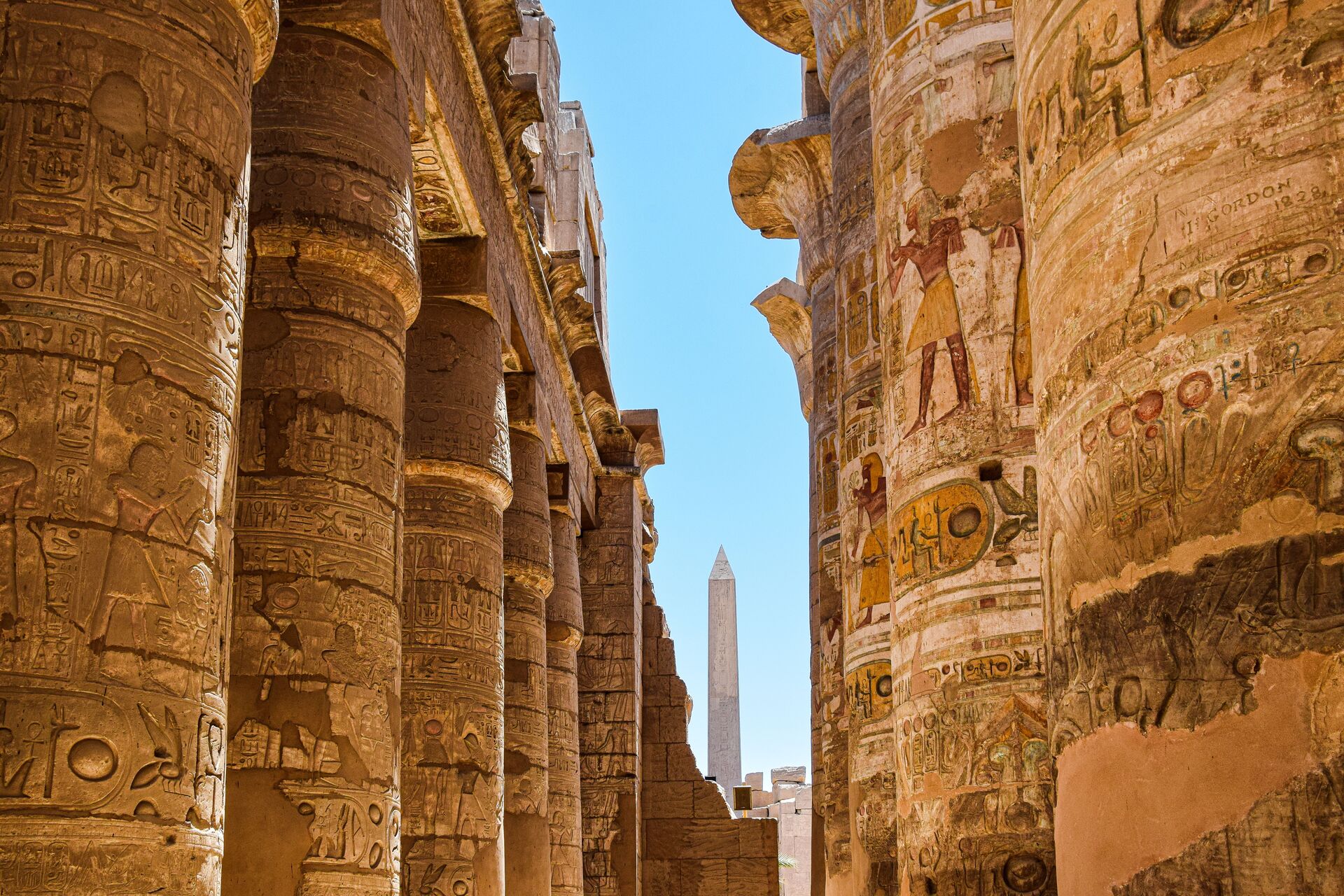
Photo: Karnak Temple Egypt
Search our Network. Start here.
Egypt has more great museums than most continents. Some are brand new and among the most visited in the world; some are a century old and still crammed with treasures in dusty wooden cases. This page goes through them one by one: what each is worth, what it costs you in time, and where the crowds are.
Before you go: how Egypt's museums work
Prices differ by nationality. Egyptians pay one price, Arab and foreign visitors pay much more, and students and residents get reduced rates with proof. Prices change often, sometimes twice a year, so check before you go. The biggest museums now sell tickets online for timed slots. Arrive at opening time: by late morning the famous rooms are full of tour groups. And keep some time free: many of the best objects are in the quieter rooms that groups walk straight past.
The Grand Egyptian Museum, Giza
The new giant at the edge of the Giza plateau, two kilometres from the pyramids, fully opened in November 2025. More than 100,000 objects, the complete treasure of Tutankhamun shown together for the first time, and a grand staircase lined with colossal statues. Around 5.2 million people visited it in its first year. Since 1 November 2026 the adult ticket for Arab and foreign visitors costs EGP 1,830 (about US$35), with reduced rates for students, children and foreign residents. Tickets are sold online only, for a timed slot. Plan three to four hours, and combine it with the pyramids in one long day.
The Egyptian Museum, Tahrir Square, Cairo
The pink building on Tahrir Square, opened in 1902, was for more than a century the home of Egypt's treasures. Many famous pieces have moved to Giza, but the old museum is still overwhelming: rooms of statues, coffins and papyri, displayed the old-fashioned way, often with handwritten labels. It is cheaper and calmer than the new museum, and for many visitors it is the more moving of the two.
The National Museum of Egyptian Civilization, Fustat, Cairo
In April 2021 twenty-two royal mummies, among them Ramses II and Hatshepsut, were moved here from Tahrir in a televised night-time procession through Cairo. They now lie in a dark, quiet hall. The rest of the museum tells Egypt's story from prehistory to the present, including the Coptic and Islamic centuries.
The Coptic Museum, Old Cairo
Inside the Roman fortress of Babylon, next to the Hanging Church, this museum holds textiles, icons, carved wood and manuscripts from Egypt's Christian centuries. It shows what is easily forgotten: that Egypt was one of the first Christian lands, and that the Coptic Church is still part of daily life.
The Museum of Islamic Art, Cairo
One of the great collections of Islamic art in the world: carved wood, metalwork, ceramics, lamps from the mosques of medieval Cairo. Combine it with a walk through historic Cairo, a UNESCO World Heritage Site, and the mosques of Ibn Tulun and Sultan Hassan.
Luxor Museum and the Mummification Museum
On the Nile corniche in Luxor, the Luxor Museum is small, beautifully lit and calm, the perfect counterweight to the crowded tombs of the West Bank. Nearby, the small Mummification Museum explains how embalmers worked, with the tools, the natron and even mummified animals. It is the place to understand finds like the golden tongues discovered in 2026 at Terenouthis.
The Nubia Museum, Aswan
The story of Nubia, the land south of Aswan that reaches into today's Sudan, and of the villages flooded by Lake Nasser after the Aswan High Dam. It tells of the Kushite kings who ruled Egypt as the 25th Dynasty, and of the Nubian people who were resettled in the 1960s. Visit it before you go to Abu Simbel.
Alexandria
Alexandria has its own museums: the Alexandria National Museum in a restored palace, covering the city from the Pharaohs to the present, and the Bibliotheca Alexandrina, the modern successor to the ancient library, with museums and exhibitions inside. The city's Greek and Roman past is everywhere, from the catacombs of Kom el-Shoqafa to the ruins along the coast.
Treasures you cannot see yet
Egypt announces new discoveries almost every month: in 2026 alone, gold-tongued burials at el-Bahnasa, Marina el-Alamein and Terenouthis, and a Byzantine town in the Dakhla Oasis. Most finds go into storage and study first, and it can take years before they reach a museum. Our Egypt site follows these discoveries as they are announced.
Egypt's museums are African museums
It is easy to see Egypt's treasures as a world apart. They are not. Egypt's civilisation grew along an African river, in constant contact with Nubia and the lands to the south. Visit the Nubia Museum, look at the Kushite kings in the Grand Egyptian Museum, and the African story of ancient Egypt becomes impossible to miss.
Photo: Karnak Temple Egypt
A licensed Egyptologist turns stone into stories. Entrance fees are included in the tour price; tips are not included but are always welcome. Tour links are affiliate links.
Updated and fact-checked: 21 November 2026.
How this page was checked. The Grand Egyptian Museum's full opening in November 2025, its ticket prices from 1 November 2026 and its first-year visitor figures were checked against the sources above. The move of the royal mummies to the National Museum of Egyptian Civilization in April 2021 is on the public record. Opening hours and prices for Egyptian museums change often and differ for Egyptians, Arab and foreign visitors; check before you go.
Written and researched by Remo Kurka · africanindependence.com
We strive to unify diverse narratives from across Africa, showcasing the continent's shared heritage and unique stories.
Our mission is to honor and preserve the history of African cultures and independence movements for future generations.
We provide a platform for innovative exchange of ideas, resources, and insights, understanding that knowledge should be accessible to all.